
You’ve Decided to Renovate. Now What?
Part 2 of 4 in the Renovation Series
Congratulations, you’ve made the decision to renovate your home! Now comes the part nobody really prepares you for, and honestly, the part I find myself talking about most with clients once the excitement of the decision settles in. Things are about to get real, but in the best way. Grab a coffee and settle in.

This is Part 2 of a four-part series. If you haven’t read Part 1, Is Now the Right Time to Renovate, start there. It covers the timing question and what your home is already trying to tell you. This post picks up where that one leaves off.
This post is for any size project. A full gut renovation and a single bathroom remodel run on the same principles, the scale changes but the preparation doesn’t. Whether you’re taking your home down to the studs or finally tackling that one room you’ve been living around for years, everything here applies.
The clients I’ve watched move through renovation projects with the most ease, the ones who come out the other side with their sanity intact and their homes transformed, are almost always the ones who did the unglamorous preparation before the first wall came down. That’s what this post is about.
Someone once said that luck is what happens when preparation meets opportunity. I’d say a smooth renovation is what happens when excitement meets preparation. You’ve got the excitement. Now let’s build the rest.
If you're still in the early thinking stage, my free No-Fail 10-Step Home Design Checklist is a good place to begin.
(It opens in a new tab so you won't lose your place.)

The Right Order of Events (Most People Get This Backwards)
Most people picture a renovation starting with a contractor showing up and things getting torn apart. In reality, what happens before that moment is what determines whether the whole project goes well or sideways.
Start with your wishlist. Remember in the first post when we talked about listening to what your home is already telling you? Now is when you put all of that on paper. Before anyone else gets involved, get clear on what you want, not just aesthetically but functionally. One question worth sitting with first: is this your forever home, or a stepping stone? The answer shapes every decision ahead. A forever home earns different investments and gives you more permission to make it truly yours. A stepping stone calls for more restraint around trends, which move fast and can date a renovation before you’ve finished paying for it. Write it all down so that this becomes the foundation everything else builds on.
Bring in a designer, an architect, or both, depending on the scope of your project. For structural work and permits, an architect will be involved. For layout, flow, and whether the space truly serves your family, a designer is often the right first call. Before either one arrives, ask yourself honestly how much of this you’re planning to do yourself. Be clear about where DIY ends and where the professionals begin. Blurry lines there cause delays.
What a designer brings that’s different from an architect or contractor is a way of seeing whether your plans truly serve you. One of my favorite examples is something I came up with for a client: a laundry chute from the second floor master closet straight down to the laundry room below. Just a small opening in the right place and suddenly nobody is lugging heavy baskets down the stairs anymore. The architect on that project was not thrilled when I suggested it 🤭. I’ve changed quite a few city-approved drawings over the years because architects design beautiful spaces but they don’t always design for how families actually live. That client went back through the entire city approval process to incorporate the change because they felt it was undeniably fun and convenient.
Bring a designer in before the drawings are finalized if you possibly can. Even a single floor plan consultation can save you from decisions you’ll spend fifteen years wishing you’d made differently. The whole next post in this series is about exactly that.
Your contractor weighs in on feasibility once plans are taking shape. A good contractor does more than quote, they tell you what’s actually buildable, flag what the drawings haven’t accounted for, and bring real-world knowledge about time, materials, and sequencing. The formal quote and committed timeline come once drawings are finalized and decisions are locked.
Before work begins, establish how your team will communicate. Who provides weekly updates? Who are the final decision makers on your end? These conversations feel unnecessary when everything is going smoothly and essential when it isn’t, so make sure to have them early.
Finally, the city. Your contractor or architect handles permit submission, but nothing moves until the plans are fully locked. City permitting takes longer than almost everyone expects, sometimes weeks, sometimes months. Build that time into your timeline from day one. Making changes after city approval restarts the clock entirely, and that is a situation worth doing almost anything to avoid.
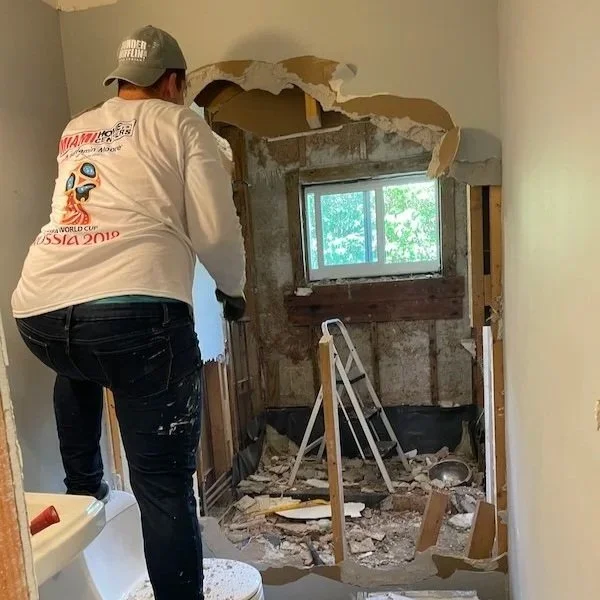
The Domino Effect: Why One Decision Changes Everything
Here’s something I wish more people understood before they fall in love with something on Pinterest: almost every design decision has downstream consequences, and the ones that feel purely cosmetic often aren’t in real life. This is why having your team involved early matters so much. They can see the dominoes before they start falling in a way that’s nearly impossible to do on your own.
Removing a wall sounds simple until you open it and find plumbing that needs rerouting, electrical that isn’t up to code, or HVAC ductwork the whole system depends on. Some of what you find has to be addressed whether it was in your plan or not. This is part of renovating. It’s the reality of working inside a home that has a history.
The same logic applies to finishes. Want a cooktop in an island where there’s currently no plumbing or electrical? That work runs through the floor, which affects your flooring decisions. Knock down a wall and you’ll almost certainly need to address the floors on both sides. And if you’re doing floors in one part of the main level, you’ll almost always want to do the whole floor, because a seamless floor through connected spaces makes a home feel larger and more cohesive than patchy sections ever will. Don’t spend money redoing floors in a space if there’s any chance you’ll be knocking down a wall nearby later. It’s best to think in sequence.
Build a contingency into your budget from the beginning. Ten to twenty percent on top of your estimated costs is realistic for most projects. When your contractor uses the words “change order,” you want to already know what that means and have the cushion to absorb it. The finances of renovating deserve a fuller conversation, and I’m dedicating all of Part 4 in this series to exactly that.
When You Need to Get Out: Planning Where Your Family Will Live
This decision often gets thought about last, and it should be one of the first. For smaller, more contained projects, one bathroom, a kitchen refresh, a room that can be sealed off, staying home is usually manageable. You live around the work zone and get through it. Being present has real advantages too. You’re available when a ten-minute decision needs to be made, and there’s something genuinely satisfying about watching a space transform in real time.
For larger projects, or for anyone who knows that living in construction chaos will genuinely affect their wellbeing and their relationships, getting out is the smarter choice. Summer works well for this. Kids are out of school, schedules are looser, and if you were planning to travel anyway you can fold that into the construction timeline. I’ve had clients rent a condo for eight weeks and come home to a transformed space, with kids who still talk about that summer away as one of their best.
Whatever you decide, build the full cost into your budget honestly, and I mean the full cost. Temporary housing, storage, packing everything twice, it adds up significantly. And about packing for a renovation, it is essentially moving. Every cabinet, every closet, every room has to be sorted, wrapped, and labeled in a way that makes sense when you’re unpacking on the other side. Budget for it, and use the process as the purge it should be. What you let go of now is the breathing room you’ll feel when you move back in.
Still figuring out where to begin? My free No-Fail 10-Step Home Design Checklist walks through the same process I use with clients.
(It opens in a new tab so you won't lose your place.)
The Emotional Side of This Is Real, and Worth Preparing For
Around week four or five of almost any project, the beginning excitement can start to fade. The end isn’t visible yet, and you’re being asked to choose between two versions of a cabinet pull while standing in what used to be your kitchen, eating takeout for the third week in a row. This is completely normal. I’ve watched it happen with clients who had renovated before and knew what was coming.
Make as many decisions as you can before work starts. Every selection locked in ahead of time is one fewer choice you’ll be making under pressure, and the decisions made under pressure are almost always the ones people second-guess for years.
Also, if you and your partner process things very differently, talk about that before demo day. Knowing how each of you operates under stress lets you plan around it instead of discovering it mid-project. And if the friction between you tends to run high around big decisions, that’s one of the things a designer is genuinely there for, someone in the middle who can hold the vision steady and keep things moving. More on that in Part 3.
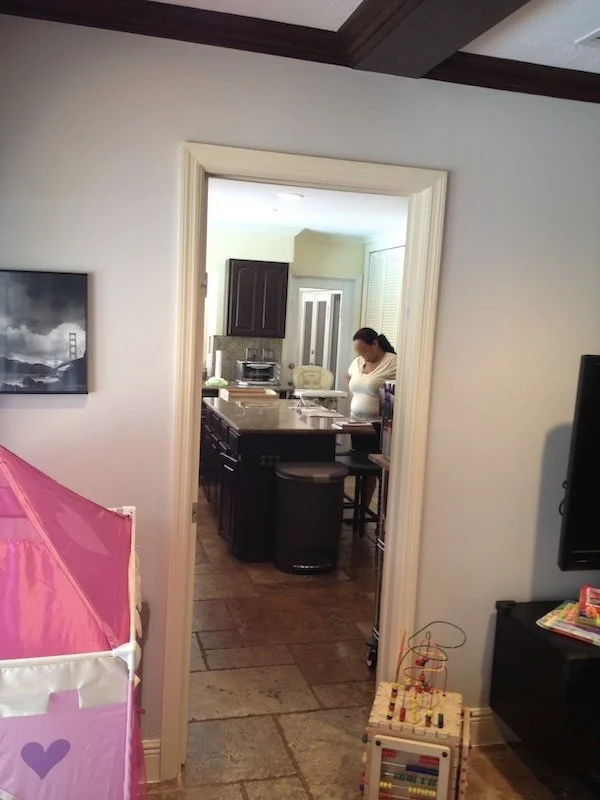
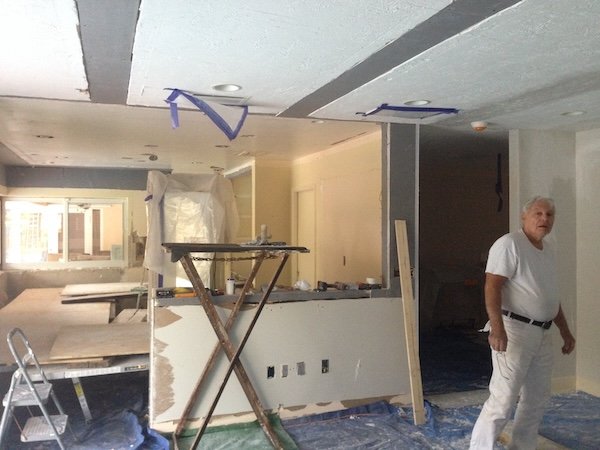

Before, during, and after — a kitchen that finally opened up to the rest of the home. The during is always harder than you think. The after is always better than you imagined.
A Few Things People Consistently Forget
• Take photos of every room, every wall, and every ceiling before anything is touched. This is for your own records, your contractor’s reference point, and potentially your insurance documentation. You will be glad you have them.
• Tell your neighbors before work begins, the start date, the expected duration, the work hours. Construction noise at seven in the morning is much easier to absorb when it isn’t a surprise.
• Seal off the parts of your home that aren’t being worked on. Renovation dust travels much further than most people expect. Plastic sheeting over doorways, vents covered, furniture wrapped or moved.
• Block at least five hours a week on your calendar for the duration of the project. The clients who try to manage from a distance are the ones who end up with regrets about choices that got made without them.
• Read your contract payment schedule before you sign. Payments tied to project milestones protect you. Payments tied to calendar dates generally don’t.
If you’re someone who likes to see everything at a glance, I put this together for you.

The Other Side of All of This Is Worth It.
There’s no mood board for permits and dust and unexpected invoices and takeout for the third week running. But I have watched families walk through finished spaces and feel everything it took to get there wash over them, and know without question it was worth it.
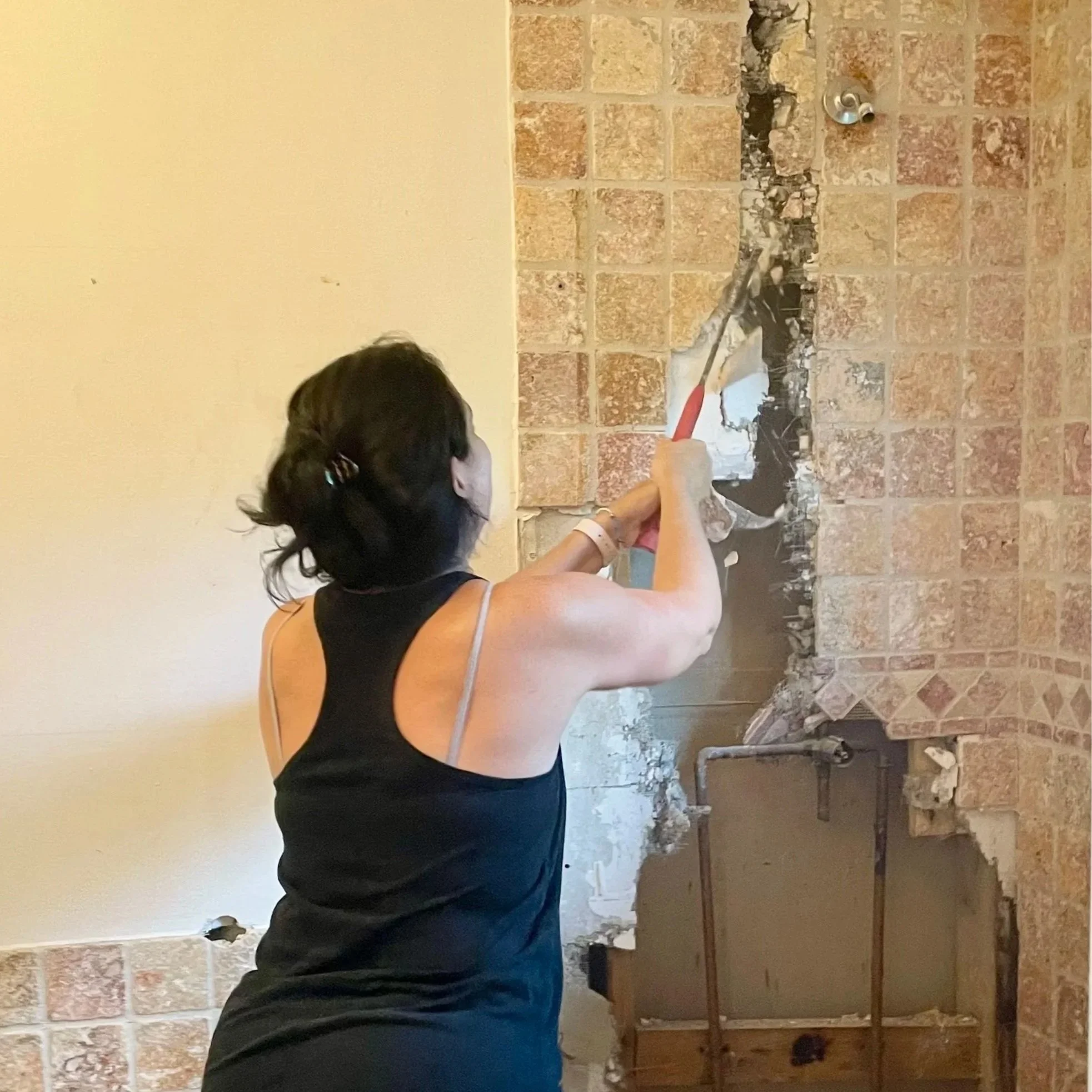
One more thing, and I mean it sincerely. Some people would give anything to be in the position of renovating their home. The chaos is real, the cost is real, the exhaustion is real, but it is also a privilege. I renovated a bathroom in my own house, my son’s bathroom, that I had disliked for fifteen years, all while delivering gorgeous bathrooms for lots of clients. The day I finally swung that sledgehammer was one of the most satisfying moments I’ve had in all my years of doing this work. Hold onto what you’re building toward. Let yourself look forward to it, even in the hard middle of it. That’s part of how you get through.
I think about this every time I’m deep in a project with a client, when the decisions feel endless and the finish line isn’t in sight yet. The disruption is real and it is also temporary. The home you’re building is going to outlast every hard moment it took to get there. And one day, not that far from now, I’ll get invited to the housewarming. That moment is always worth it.

This is Part 2 of a four-part series. Part 1, Is Now the Right Time to Renovate, is where the conversation starts. If you haven’t read it, start there.
Coming in Part 3: what I wish every client knew before working with a designer, and why bringing one in earlier than you think changes everything.
My free No-Fail 10-Step Home Design Checklist is a solid place to begin if you’re still in the thinking stage. cococuratedliving.com/checklist
And if you want the deeper framework before any design decisions get made,my ebook The Real Resetbuilds on exactly that foundation.
